Chapter 8: The Maillard Reaction
Chapter 8: The Maillard Reaction
Part III: The Roasting Transformation
The roastery was in a converted garage in Poblenou, Barcelona’s old industrial district that has been slowly reinventing itself as a neighborhood of design studios, craft breweries, and specialty coffee operations. I had been invited by Jordi, a roaster whose reputation in the Spanish specialty coffee scene far exceeded the modesty of his workspace: one vintage Probat drum roaster, a cooling tray, a laptop running Cropster logging software, and bags of green coffee stacked floor to ceiling along the back wall.
I was there to watch. To observe with a physicist’s eyes what happens when raw agricultural material is transformed into one of the most aromatically complex substances humans consume.
Jordi loaded the drum with a batch of washed Ethiopian Yirgacheffe — pale green beans that smelled, frankly, like wet grass and raw peanuts. Not unpleasant, but nothing you would recognize as coffee. He set his charge temperature, slid the beans into the drum, and turned to me with the calm of someone who has done this ten thousand times.
“Now we wait,” he said. “The beans will tell us what to do.”
For the first few minutes, nothing dramatic happened. The beans absorbed heat, their color shifting almost imperceptibly from green toward yellow. Jordi monitored his rate-of-rise curve on the laptop, adjusting the gas flame in tiny increments. Then the color began to change more visibly — yellow deepening to gold, gold to amber. A rich, complex aroma started filling the garage, something between toasted bread and caramelized sugar with an undertone I could not quite place.
“Smell that?” Jordi said. “That is the reaction. Everything changes now.”
Around the nine-minute mark, I heard it: a series of sharp cracks from inside the drum, like distant popcorn. First crack — the moment when steam pressure inside the beans exceeds the structural strength of the cell walls and they physically fracture. Jordi leaned in, listening. “This is where development starts. From here, every second matters.”
I watched him work — adjusting airflow, modulating heat, tilting his head to listen to the frequency and intensity of the cracking — and I thought about what I knew was happening at a level no human sense could detect. Inside every one of those beans, at that very moment, sugars were reacting with amino acids in a cascade of chemical transformations that would produce hundreds of new compounds. Brown polymers were assembling themselves from smaller precursors. Volatile molecules were forming and escaping into the air — the very molecules I was smelling. And the energy required for each of these steps, the barriers that had to be overcome, the pathways that branched and merged and branched again — I had modeled them. I had seen the energy landscape of this reaction at the level of individual electrons.
Jordi knew what was happening by color, sound, and smell. I knew what was happening by quantum chemistry. And the beautiful thing was that we were describing the same phenomenon.
The Reaction That Makes Coffee Taste Like Coffee
Here is a thought experiment. Imagine taking a handful of green coffee beans and grinding them up, then brewing them in hot water exactly as you would brew roasted coffee. What would the resulting drink taste like?
The answer: almost nothing like coffee. It would be grassy, vegetal, astringent, and sour — closer to a harsh herbal tea than anything you would want to drink. Green coffee extract exists as a supplement, and the people who have tasted it will confirm that it bears essentially no resemblance to the beverage we know.
Everything that makes coffee taste like coffee — the bittersweet chocolate notes, the caramel undertones, the roasted nuttiness, the extraordinary aromatic complexity — is created during roasting. And the single most important chemical process driving that transformation is the Maillard reaction.
The reaction is named after the French chemist Louis-Camille Maillard, who first described it in 1912. What he observed seemed simple: heat a sugar and an amino acid together, and the mixture turns brown. But that simplicity is deceptive. The Maillard reaction is not one reaction. It is a cascading chain of dozens of chemical transformations happening in parallel and in sequence. They branch, merge, and loop back on themselves. From a small number of starting ingredients, they produce hundreds of distinct products. It is arguably the most complex non-enzymatic reaction in all of food chemistry — and it is happening every time you roast a coffee bean.
In coffee, this reaction creates the brown color you see in your cup. It creates the volatile compounds you smell when you open a bag of freshly roasted beans. It creates the flavor compounds that distinguish a light-roast Ethiopian from a dark-roast Sumatran. And it creates the melanoidins — enormous brown polymers that constitute 23-25% of brewed coffee’s dry weight and that, as I will discuss in detail in the next chapter, turn out to have remarkable chemical properties of their own.
Without the Maillard reaction, there is no coffee. There is only a green seed with potential.
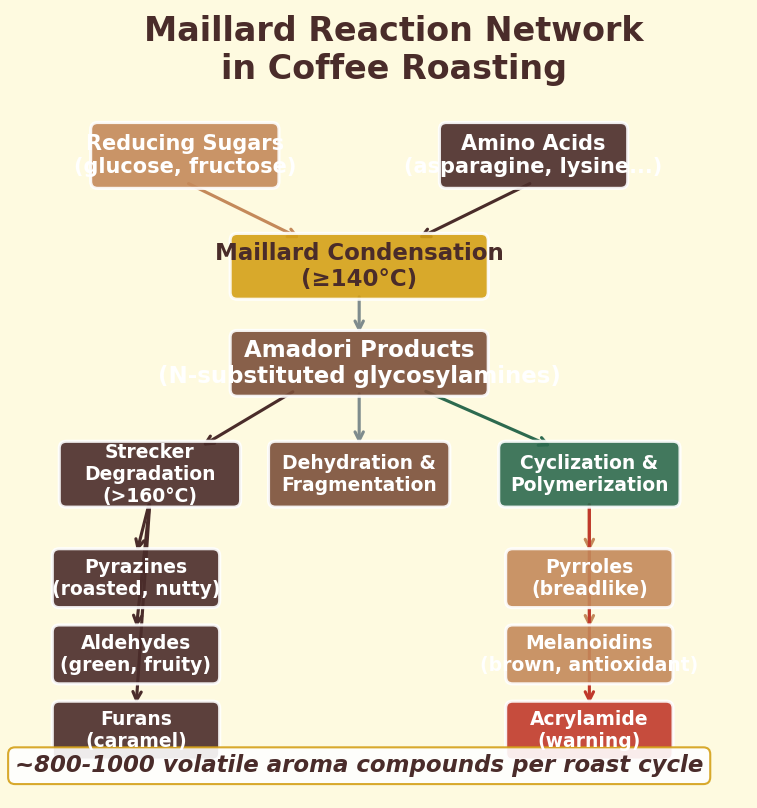
Figure 8.1a. Maillard reaction network: the branching cascade of chemical transformations from initial sugar-amino acid condensation through Amadori rearrangement to melanoidin polymerization.
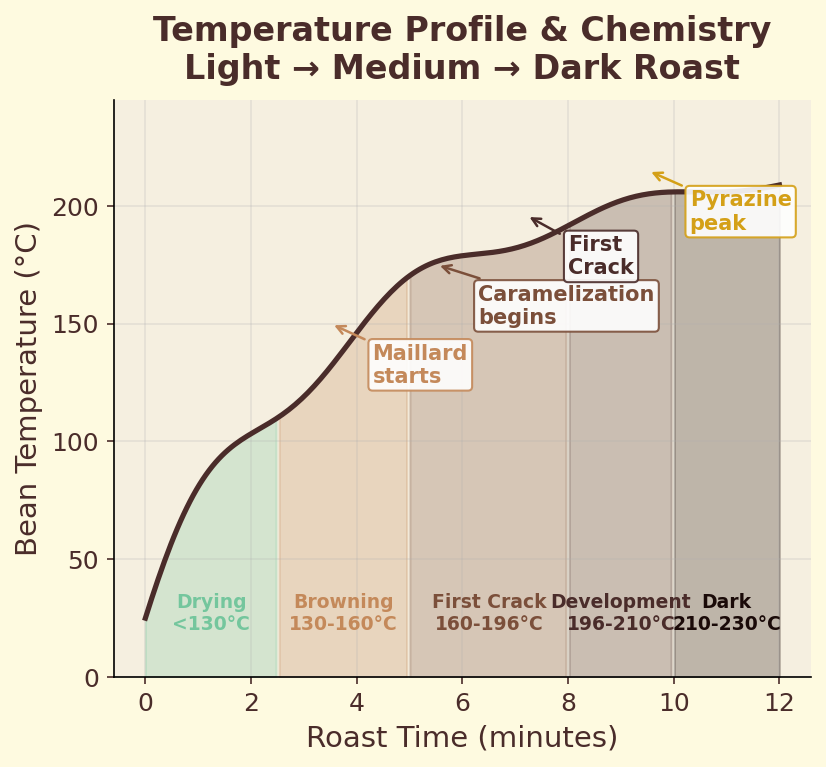
Figure 8.1b. Temperature profile and chemistry: bean core temperature progression during roasting, annotated with the chemical transitions at each stage from drying through first crack to development.
The Raw Materials
Every chemical reaction needs starting materials, and the Maillard reaction is no exception. What makes coffee particularly interesting is that the green bean comes pre-loaded with an unusually rich set of precursors — a chemical toolkit that, once heat is applied, generates a complexity of products that exceeds almost any other food.
The key precursors are three groups of compounds.
First: sucrose, present at 6-9% of the green bean’s dry weight. Sucrose is a disaccharide — a molecule made of two simple sugars, glucose and fructose, bonded together. During the early stages of roasting, heat breaks sucrose into its component sugars, and these reducing sugars become the fuel for the Maillard reaction. They are the molecules that react with amino acids to kick-start the entire cascade.
Second: free amino acids, present at 0.2-0.8% of dry weight. This might seem like a small amount, but amino acids are the other essential partner in the Maillard reaction. Each different amino acid produces a different set of downstream products when it reacts with a sugar, which is one reason coffee’s flavor profile is so complex. The bean contains a diverse population of amino acids, and each one contributes its own signature to the final product.
Third: chlorogenic acids, or CGAs, present at a remarkably high 6-12% of dry weight. Chlorogenic acids are not direct participants in the classic Maillard reaction, but they are deeply involved in the overall roasting chemistry. They degrade under heat to produce quinic acid and caffeic acid, which participate in browning reactions of their own. They also interact with Maillard intermediates, contributing to the final pool of melanoidins. The fact that coffee beans contain such a high concentration of CGAs — far more than most other plant foods — is one reason coffee generates such a complex array of roasting products.
These three groups of compounds sit inside the green bean, inert and stable at room temperature, waiting. When the roaster applies heat — typically starting around 150-170 degrees Celsius and rising to 200-230 degrees during development — the reaction begins.
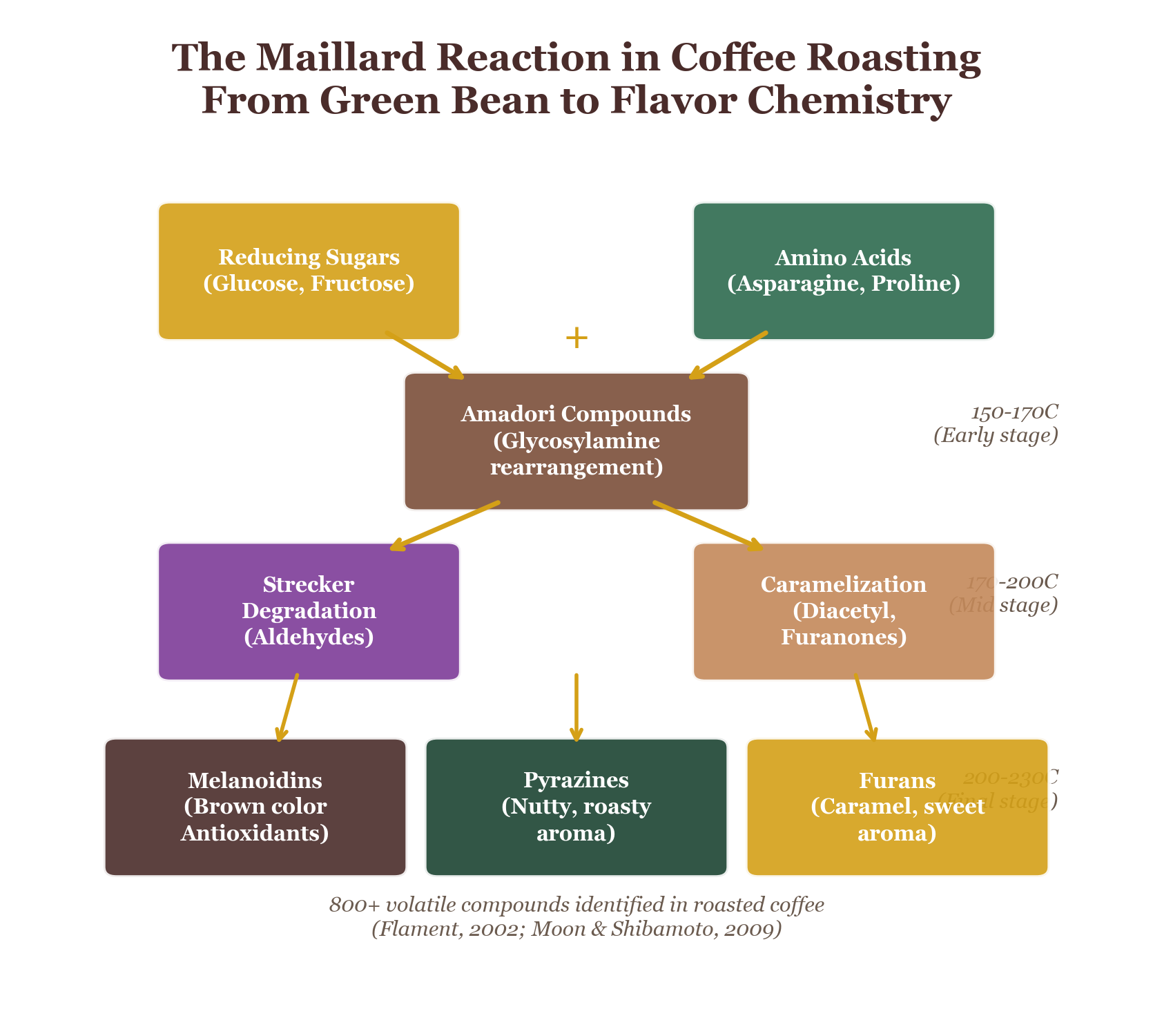
Figure 8.2. The Maillard pathway in detail: from initial sugar-amino acid condensation through Amadori rearrangement and enolization to the final polymerization of melanoidins.
The Maillard reaction is not unique to coffee. It is happening every time you apply heat to food that contains both sugars and proteins — which is to say, almost every time you cook.
The golden crust on a loaf of bread? Maillard reaction between the flour’s sugars and gluten proteins. The seared exterior of a steak? Maillard reaction between the meat’s natural sugars and amino acids from muscle protein. The deep brown surface of a toasted marshmallow? Maillard again. Even the color and flavor of chocolate, biscuits, and maple syrup owe something to this reaction.
But coffee is a special case. Most foods produce a few dozen Maillard products. Coffee produces hundreds — some estimates suggest over 800 volatile compounds have been identified in roasted coffee, a significant fraction of which are Maillard-derived. This extraordinary complexity arises from the diversity of precursors in the green bean: multiple amino acids, multiple sugars released from sucrose breakdown, and the additional contribution of chlorogenic acid degradation products that interact with Maillard intermediates. No other common food brings quite this combination to the table, which is why coffee’s aroma is one of the most complex in the natural world.
Three Stages — From Simple to Astonishing
One of the most useful ways to understand the Maillard reaction is to divide it into three stages, each progressively more complex, each producing different types of products, and each requiring different amounts of energy to proceed. This three-stage framework is well established in food chemistry, and it maps beautifully onto what a roaster observes during the roasting process.
Stage 1 — The Early Stage (Amadori Rearrangement)
The reaction begins when a reducing sugar — glucose or fructose released from sucrose breakdown — reacts with the amino group of a free amino acid. The sugar’s carbonyl group attacks the amino group, releasing a molecule of water and forming what chemists call a Schiff base. This is an unstable intermediate — think of it as a molecular handshake that has not yet been formalized into a contract.
The Schiff base then undergoes a rearrangement, shifting its internal bonding pattern to form a more stable product called an Amadori compound (named after the Italian chemist Mario Amadori). The Amadori rearrangement is the gateway to everything that follows. It is relatively straightforward chemistry — a sugar meets an amino acid, they form an initial product that rearranges into a more stable form. The early stage is also largely reversible: under mild conditions, the Amadori product can revert back to its starting materials. Nothing irreversible has happened yet.
During roasting, this stage corresponds roughly to the drying phase and the early yellowing of the beans. The chemistry is underway, but the dramatic transformations have not yet begun. The beans are losing moisture, sucrose is breaking down into reducing sugars, and the first Amadori products are forming. The roaster sees a gradual color change from green to yellow — subtle, almost gentle. The aromas are mild: hay, grain, something faintly bready.
Stage 2 — The Intermediate Stage (Enolization and Strecker Degradation)
This is where the Maillard reaction earns its reputation for complexity — and where, if you’ve ever stood near a roaster, you felt it in your nose. That moment when bready warmth suddenly gives way to something richer, darker, almost intoxicating? That’s Stage 2 arriving.
The Amadori products from Stage 1 are not the end of the road. They are waypoints — molecules standing at a fork, ready to transform in several directions depending on temperature, acidity (pH), and how much water is present. The two most important paths are called 1,2-enolization and 2,3-enolization. In plain terms, these are rearrangements where bonds within the molecule shift position, creating different reactive intermediates.
Let me translate that out of chemistry jargon. Imagine the Amadori product as a flexible chain of atoms. Under heat, this chain can bend and rearrange in two different ways, each producing a different reactive intermediate. These intermediates then go on to react with other molecules in the system, producing an ever-expanding tree of products. The 1,2-enolization pathway tends to produce furfural and related compounds. The 2,3-enolization pathway produces reductones and other intermediates. Both pathways are happening simultaneously, and their products cross-react with each other.
And then there is Strecker degradation — a side reaction where the reactive intermediates from Stage 2 attack additional amino acids. The process strips each amino acid down to a smaller fragment called an aldehyde. Each amino acid produces a different aldehyde, and each aldehyde has its own distinctive smell. 2-methylpropanal smells malty. 3-methylbutanal smells like chocolate. Methional is potato-like. Phenylacetaldehyde recalls honey. These Strecker aldehydes are among the most aromatically powerful molecules in roasted coffee. The smell of freshly roasted beans is, in large part, a chorus of these small molecules singing together.
During roasting, the intermediate stage corresponds to the period of rapid browning — the beans moving from gold to light brown to medium brown. The aromas become dramatically more complex. The roaster starts detecting notes of caramel, chocolate, nuts, and toast. First crack typically occurs during this stage, as the internal pressure from water vapor and carbon dioxide produced by the reactions exceeds the structural limits of the cell walls.
This stage is also where my computational research revealed something particularly interesting — but I will save the details for Chapter 10, where I discuss the kinetic bottleneck in depth.
Stage 3 — The Advanced Stage (Polymerization)
In the final stage, the small reactive intermediates produced in Stage 2 begin to combine with each other. They polymerize — linking together into larger and larger molecules through a series of condensation and addition reactions. The products of this polymerization are the melanoidins: enormous, heterogeneous, brown-colored polymers with molecular weights ranging from a few thousand to over one hundred thousand daltons.
If Stage 1 is a handshake and Stage 2 is a conversation, Stage 3 is the construction of an entire building. The melanoidins that emerge from this stage are not single, well-defined molecules with neat structural formulas. They are populations of related but distinct polymers, each one assembled from a slightly different combination of precursors and intermediates. This structural diversity is part of what makes melanoidins so difficult to study — and so fascinating.
This stage is largely irreversible. Once the small intermediates have polymerized into melanoidins, there is no going back. The raw materials have been permanently transformed. This is why roasting is a one-way process: you cannot unroast a coffee bean.
During roasting, the advanced stage corresponds to the later phases of development — the deep browns and, if the roaster pushes further, the near-blacks of a dark roast. The melanoidins being formed are responsible for the deepening color. They also contribute to body and mouthfeel in the brewed cup, and as I will discuss in detail in the next chapter, they have chemical properties — metal binding, antioxidant activity, interactions with gut microbiota — that make them far more than passive pigments.
The Maillard Reaction — Bean Color Transformation
0 min
~4 min
~7 min
~9 min
~11 min
~14 min
Several times in this book, I mention that I used DFT — Density Functional Theory — to study coffee chemistry at the quantum level. But what is DFT, exactly?
At its core, DFT is a method from quantum chemistry that calculates how electrons arrange themselves around atoms in a molecule. Why does this matter? Because the arrangement of electrons determines everything: the shape of the molecule, how strongly it binds to other molecules, how much energy is needed to break or form a chemical bond, and which reactions are easy and which are difficult.
The “density” in Density Functional Theory refers to the electron density — a mathematical description of where the electrons are most likely to be found around the atoms. Instead of tracking each electron individually (which becomes impossibly complex for molecules with many electrons), DFT works with this electron density as a whole, which makes the calculations tractable even for relatively large molecules.
Think of it this way. If you wanted to understand traffic flow in a city, you could try to track every individual car — where it is, how fast it is going, where it is headed. That would be accurate but overwhelming. Alternatively, you could measure traffic density — how many cars per kilometer on each road at each moment. From the density alone, you can predict congestion, estimate travel times, and identify bottlenecks. DFT does something analogous for electrons. It uses the density to calculate the energy of the system, which tells us which molecular arrangements are stable and which reaction pathways are favorable.
When I say that I used DFT to study the Maillard reaction, what I mean is that I built computational models of the key molecules and intermediates, calculated the energy of each state, and mapped out the energy landscape that the reaction traverses. It is like creating a topographic map of a mountain range: the peaks are the energy barriers that must be overcome, and the valleys are the stable intermediates where the reaction pauses before continuing to the next step.
Why Quantum Chemistry?
You might reasonably ask: the Maillard reaction has been studied for over a century. Food chemists have catalogued hundreds of its products. Roasters have been manipulating it expertly by adjusting time, temperature, and airflow for decades. What could quantum chemistry possibly add?
The answer is: the why.
Traditional food chemistry is extraordinarily good at telling you what happens during roasting. It can identify the products, measure their concentrations, and correlate them with sensory attributes. Analytical methods like gas chromatography and mass spectrometry have mapped the volatile compound profile of roasted coffee in exquisite detail. But these methods describe outcomes. They tell you what arrives at the finish line without fully explaining the race.
Density Functional Theory operates at a fundamentally different level. By calculating the energy of each molecular state — reactants, transition states, intermediates, products — it constructs an energy landscape for the entire reaction pathway. And from that landscape, you can extract something that traditional chemistry alone cannot easily provide: the activation energy of each step. The activation energy tells you how high the energy barrier is between one state and the next — how hard it is for the reaction to proceed through a given pathway.
This is the difference between knowing that a river flows from the mountains to the sea (which any observer can see) and knowing the precise topography of the landscape it flows through (which explains why it takes the path it does, where it pools, where it cascades, and where it slows to a trickle).
When I applied DFT to key steps of the Maillard reaction, the energy landscape that emerged was revealing. Our computational models showed that the early stages of the reaction — the initial Amadori pathway — require substantial activation energy, on the order of ~107 kcal/mol in our DFT calculations. This is a high barrier, and it explains something every roaster knows intuitively: you need real heat to get roasting started. The early phase is not spontaneous at room temperature. The beans must absorb considerable thermal energy before the Maillard cascade can begin in earnest.
But the energy landscape was not uniform. Different steps had different barrier heights, which means some transformations proceed quickly once conditions are met, while others are sluggish even at roasting temperatures. This variation in barrier heights creates what we might call the kinetic texture of roasting — a landscape of fast reactions and slow reactions, of pathways that race ahead and pathways that lag behind, all operating simultaneously inside the bean.
The most striking feature of this landscape — a kinetic bottleneck at the 1,2-enolization step in the intermediate stage, where the reaction slows by a factor of 75-125 compared to other steps — will be the subject of Chapter 10. But even without that specific result, the general picture that DFT provides is valuable: roasting is not a single, smooth transformation. It is a rugged energy landscape, and the roaster, whether they know it or not, is navigating that landscape every time they adjust the flame.
What Roasters Already Knew, Now Explained
One of the things I find most satisfying about this work is that computational chemistry does not contradict the roaster’s experience. It explains it.
Consider Jordi in his Poblenou garage, listening for first crack. He knows that the beans need to reach a certain temperature before first crack occurs, and that if he rushes the early phase — applying too much heat too fast — the outside of the bean will develop while the inside remains underdeveloped, producing a cup that tastes both burnt and grassy at the same time. Every experienced roaster knows this. They call it “scorching” or “tipping,” and they avoid it by managing the rate of rise carefully during the drying and yellowing phases.
From the perspective of the energy landscape, this makes perfect sense. The early Maillard stages have high activation energies. If heat is applied too aggressively, the surface of the bean reaches those activation thresholds long before the interior does. The surface races through the early and intermediate stages while the center of the bean is still in the drying phase. The result is a heterogeneous roast — multiple stages of the Maillard reaction coexisting in a single bean, producing contradictory flavor signals in the cup.
Or consider the concept of development time — the period between first crack and the end of the roast. Roasters know that extending development time changes the flavor profile from bright and acidic to sweet and chocolatey to roasty and bitter. They manipulate this window carefully, often measuring it to the second.
What is happening during development time? The intermediate and advanced stages of the Maillard reaction are proceeding. Strecker degradation is producing aromatic aldehydes. Enolization is generating reactive intermediates that will eventually polymerize into melanoidins. The longer the development time, the further the reaction progresses toward the advanced stage, and the more the flavor profile shifts from the brightness of early-stage products toward the depth and body of melanoidin-rich late-stage products.
The roaster adjusts development time based on what they want in the cup. The quantum chemistry explains why those adjustments produce the effects they do.
And then there is the progression of aromas during roasting — something that Jordi and every roaster tracks as an essential quality indicator. The shift from grassy and bready (early stage) to caramel and sweet (early-to-intermediate transition) to chocolatey and nutty (intermediate stage) to smoky and ashy (late advanced stage) is a direct olfactory map of the three Maillard stages. Each stage produces a characteristic set of volatile compounds, and as the reaction progresses, the balance of volatiles shifts, carrying the aroma profile with it.
Computational chemistry does not replace the roaster’s nose. It will never replace the roaster’s nose. But it tells us what the nose is detecting, why those compounds form when they do, and what controls the rate at which one aromatic regime gives way to the next. It provides a molecular narrative for a sensory experience.
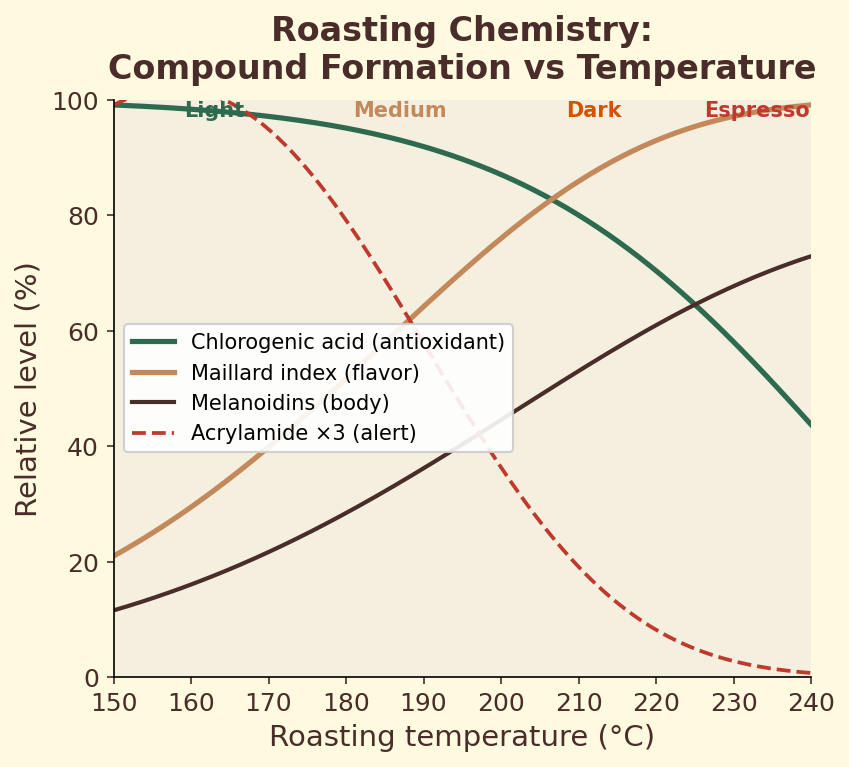
Figure 8.3a. Compound formation: concentration curves of key chemical species as roasting temperature rises, showing sucrose degradation, Amadori product accumulation, and melanoidin buildup.
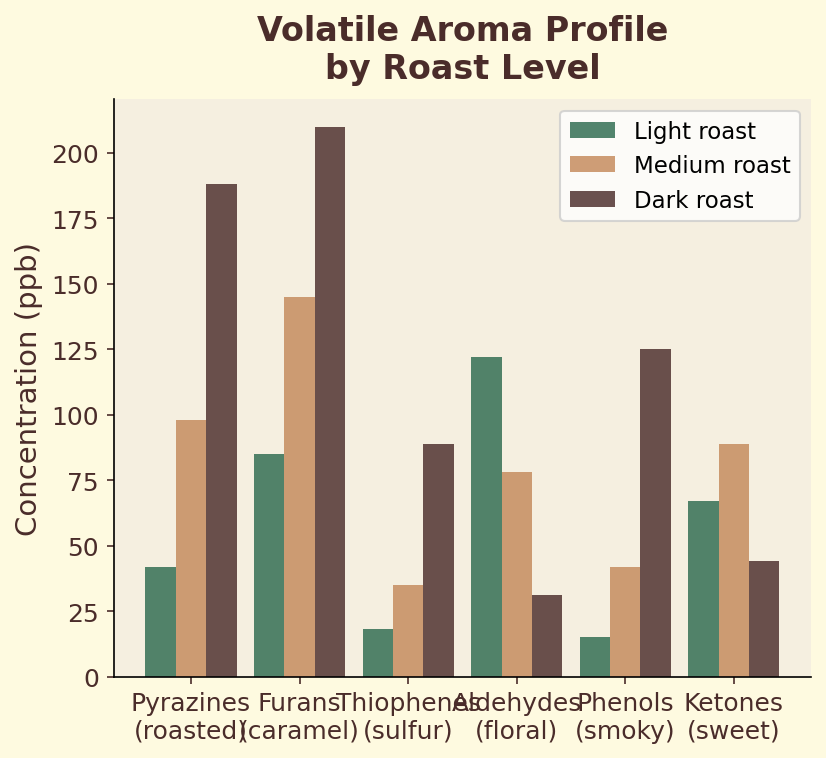
Figure 8.3b. Volatile aroma profile: relative abundance of pyrazines, furans, aldehydes, and thiophenes at light, medium, and dark roast levels.
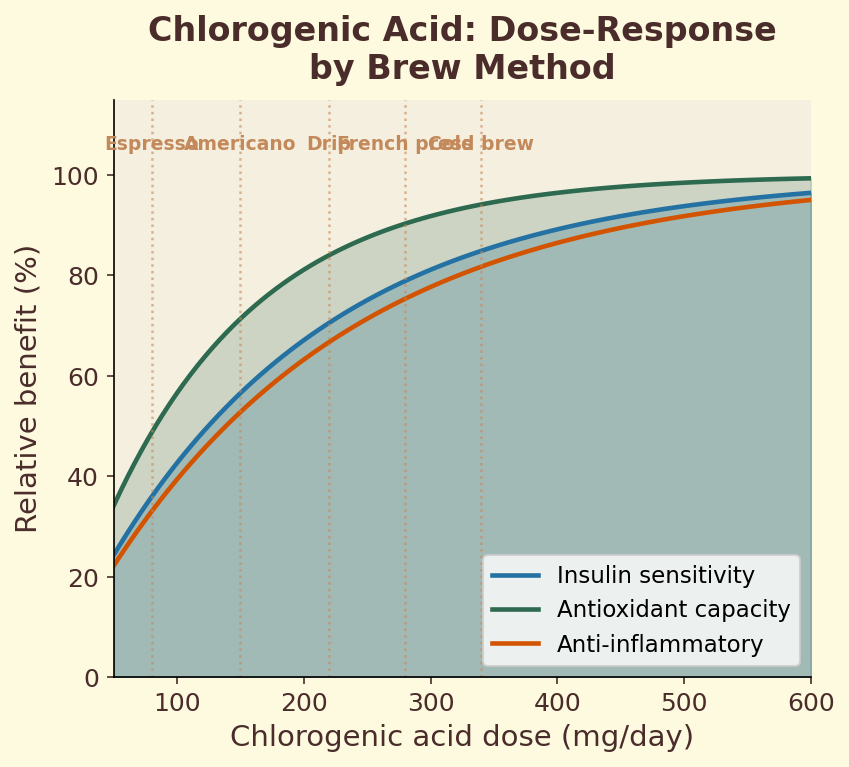
Figure 8.3c. Chlorogenic acid dose-response: CGA retention as a function of roast degree, showing the progressive degradation from 6-12% in green beans to below 1% in dark roasts.
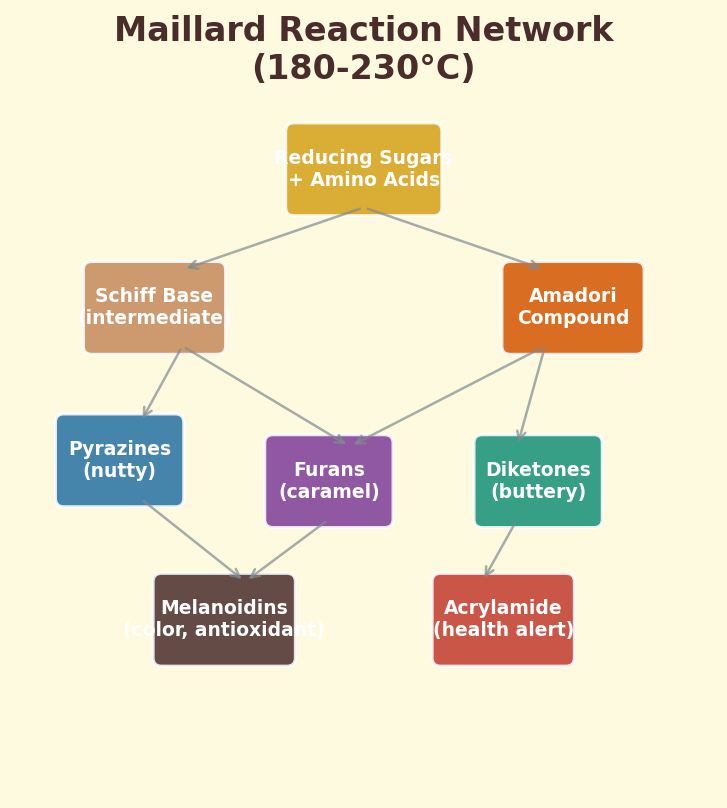
Figure 8.3d. Maillard reaction network: detailed pathway diagram showing the parallel and sequential transformations from Amadori compounds through Strecker degradation to melanoidin polymerization.
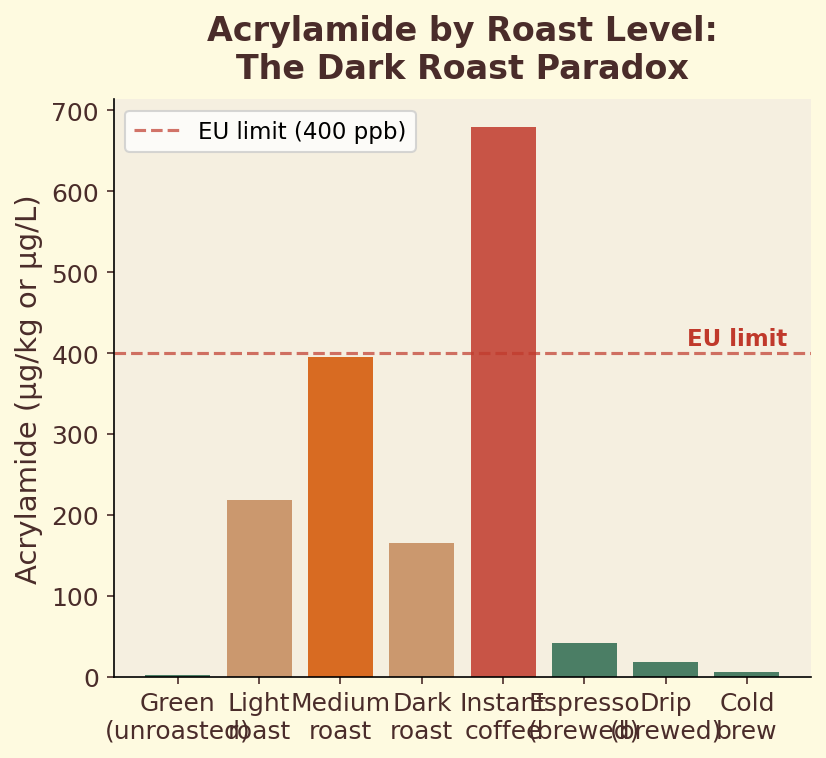
Figure 8.3e. Acrylamide content: formation and subsequent degradation of acrylamide across roast levels, peaking at light-medium roast before declining at darker profiles.
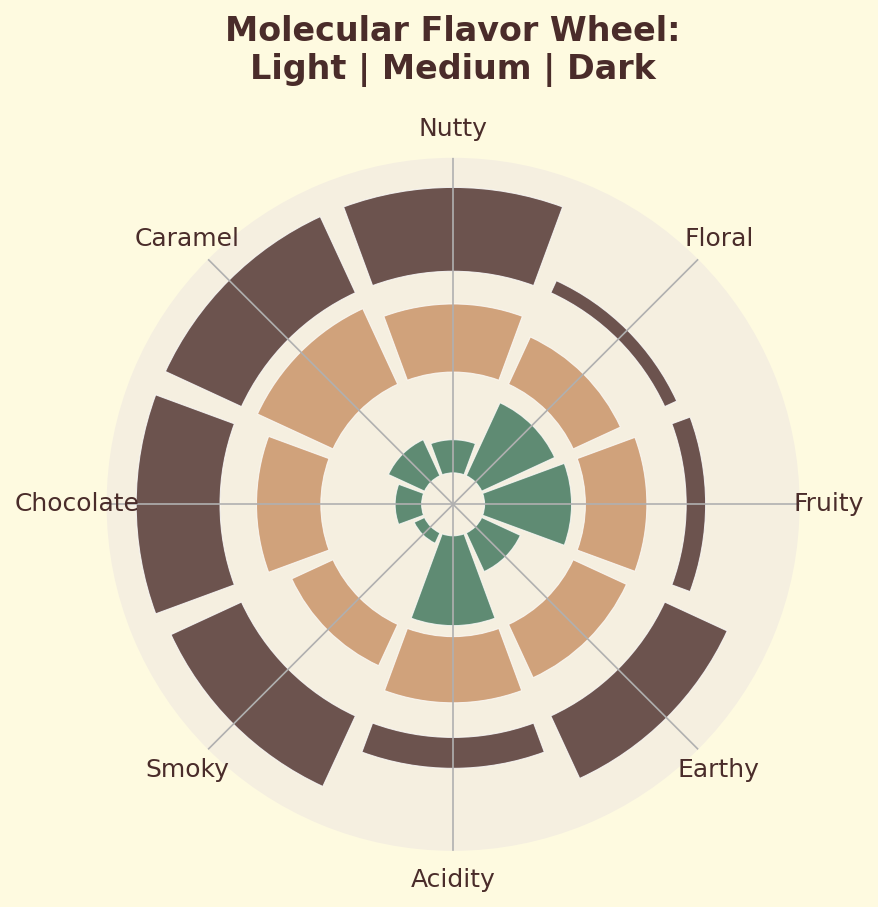
Figure 8.3f. Molecular flavor wheel: mapping volatile compound classes to sensory descriptors across the roasting spectrum, from fruity-floral in light roasts to smoky-spicy in dark roasts.
The Maillard Reaction: From Green to Brown
Animation: A coffee bean's chemical journey through roasting stages.
The Maillard reaction is often called a “browning reaction,” and technically that is accurate — it does produce brown color. But calling the Maillard reaction a browning reaction is like calling a symphony “noise.” It dramatically undersells what is actually happening.
Consider what the Maillard reaction produces in coffee alone: hundreds of volatile aroma compounds, including furans (caramel notes), pyrazines (nutty, roasted notes), pyrroles (sweet, cereal notes), thiophenes (meaty, savory notes), and the Strecker aldehydes that provide some of coffee’s most distinctive aromas. It produces the melanoidins that give coffee its body, its color, and a significant portion of its antioxidant activity. It produces organic acids that contribute to acidity. It produces bitter compounds that balance the sweetness.
All of this from a sugar meeting an amino acid. The browning is almost an afterthought — a visible byproduct of a transformation that is primarily about creating flavor, aroma, and an entirely new chemical universe from precursors so simple they fit on a cocktail napkin. The next time someone tells you the Maillard reaction is “just browning,” you have my permission to object.
Every morning, when you grind roasted coffee beans and add hot water, you are dissolving and extracting the products of the Maillard reaction. The brown color of your cup comes from melanoidins. The aroma that fills your kitchen comes from volatile Maillard products — Strecker aldehydes, furanones, pyrazines, and hundreds of others. The flavor complexity that distinguishes a specialty single-origin from a commodity blend is, in large part, a reflection of how skillfully the roaster navigated the three stages of the Maillard cascade.
The Maillard reaction is not an obscure academic curiosity. It is the reason coffee exists as a beverage. It takes a green seed that tastes like grass and transforms it, through a cascade of chemical events that starts with a sugar meeting an amino acid and ends with the assembly of giant brown polymers, into one of the most aromatically complex and chemically rich substances in the human diet.
What fascinated me most about studying this reaction computationally was the gap between its simplicity at the starting line and its staggering complexity at the finish. Two common molecules — a sugar and an amino acid — react under heat, and the result is an avalanche of chemistry that no one has fully catalogued even after more than a century of study. The energy landscape I mapped with DFT revealed why: the reaction does not follow a single path. It follows many paths simultaneously, branching at every stage, with different barrier heights directing different fractions of the material down different routes.
And as we will see in the next two chapters, the products of this cascade — especially the melanoidins that emerge from the advanced stage, and the kinetic bottleneck that governs how the intermediate stage unfolds — have implications that extend well beyond flavor. The Maillard reaction does not just make your coffee taste good. It creates molecules with properties that are only now beginning to be understood.
Jordi, back in his Poblenou garage, would probably shrug at all of this. He already knows what matters: listen to the beans, watch the color, trust your nose. But I think he would appreciate knowing that when he adjusts his gas valve at the eight-minute mark, he is steering a reaction across a quantum energy landscape — and that his intuition, honed over thousands of roasts, has been navigating that landscape all along.
How the Maillard reaction creates the same flavor spectrum in toast as in coffee roasting
You'll Need
- White bread
- Toaster with adjustable settings
- Plate
- Notebook
Do This
- Toast 4 slices at different levels: barely toasted, light golden, medium brown, dark brown.
- Line them up from lightest to darkest.
- Smell each slice — note the aroma progression.
- Taste each — note sweetness, bitterness, complexity.
- Compare your notes to the Maillard products discussed in this chapter.
What's Happening
Toast undergoes the exact same Maillard reaction as coffee beans during roasting. Light toast = early Maillard products (sweet, bready). Dark toast = advanced Maillard products (bitter, smoky). You've just created a visible, edible gradient of the same chemistry that turns green beans into roasted coffee — melanoidins, furans, pyrazines, and all.
“The Maillard creates hundreds of products. The biggest — melanoidins — make up a quarter of your coffee by weight. And we barely understand them.”